Eduard Ter-Ghazaryan
A violinist, inventor and sculptor whose works are smaller than the eye of a needle. Often called the founder of the art of micro-miniature, he carved figures onto human hair and grains of rice that can only be seen under a microscope.
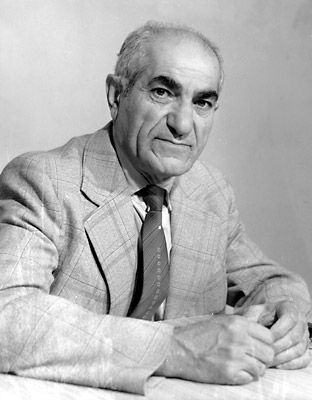
Gallery
Click a photo to enlarge. Use the arrow keys or swipe to move between photos.
Life and work
Eduard Ter-Ghazaryan was born in Yerevan and began violin lessons at the age of six. At thirteen he built his first violin, no bigger than a match head. In 1937 his father, a senior official, was arrested, and the family spent about two decades living in a basement, where much of his early fine work was done in poor light.
Trained as a musician, he worked for many years as concertmaster of the Armenian Philharmonic Orchestra while developing his micro-art. In 1947 he showed his first works invisible to the naked eye in Yerevan. Over his life he created more than a thousand micro-sculptures: carvings on hair and rice grains and scenes placed inside the eye of a needle.
His most original contribution was the “movable micro-work”: microscopic figures that actually move. He was also an inventor and violin maker. He revived an 18th-century instrument, the viola pomposa, and built the “Peace Music Automaton” (1987), a gun-shaped machine carrying about forty instruments from different nations. He also produced ultra-fine needles used in eye surgery.
His tradition continues through his grandson, also named Eduard Ter-Ghazaryan. Works by both are shown at the Ter-Ghazaryans’ Micro Art Museum in Yerevan.
Key dates
- 1923Born in Yerevan on 20 June.
- 1936Builds a violin the size of a match head, aged 13.
- 1947First exhibition of works invisible to the naked eye, in Yerevan.
- 1983Cited nine times in the Soviet book of records Divo.
- 1987Completes the “Peace Music Automaton”.
- 2006“Living Legend” gold medal, International Biographical Centre, Cambridge.
- 2010Medal of St. Sahak and St. Mesrop from Catholicos Garegin II.
- 2012Dies in Yerevan on 16 April, aged 88.
- 2018Ter-Ghazaryans’ Micro Art Museum opens in Yerevan.
At a glance
- Title
- Honoured Art Worker of Armenia
- Fields
- Micro-sculpture, violin making, music, invention
- Materials
- Human hair, rice grains, needle eyes
- Innovation
- Moving micro-sculptures
Where to see his work
Ter-Ghazaryans’ Micro Art Museum
Yerevan, Armenia's first museum of micro-miniatures, opened in 2018. It shows works by Eduard Ter-Ghazaryan and his grandson under microscopes.
Phone: +374 12 505 515
Hovhannes Sharambeyan Museum of Folk Arts
Abovyan St. 64, Yerevan. Its collection includes micro-miniatures by Ter-Ghazaryan.
See it in the museum directory →
Addresses and opening hours change, so please contact the museum before visiting.